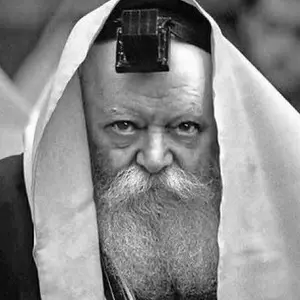

הערת כ"ק אדמו"ר מה"מ שליט"א באגה"ק סי' ז' בל' "אין לו חלק באלקי ישראל"
In the note of the Rebbe, Melech HaMoshiach, שליט"א, to the Shiurim in Sefer HaTanya, Iggeres HaKodesh, ch. 7 (ע' 1328), on what the Alter Rebbe wrote, "the expression common in the sayings of our Sages of blessed memory, 'he has no portion in the G-d of Israel'": "For the time being I have found it only in Tanchuma, end of Parshas Tazria, but in very many places it appears as 'you have no' (ב"ר פ"ב, ד. וש"נ. הובא בתו"א ל, רע"א), and likewise 'they have no' (ברכות סג, ב). One may say that he did not want to quote the second-person form, nor the plural form. And this is simple."
However, at first glance this is utterly astonishing, for there is an explicit Gemara before us in Tractate Sanhedrin (the tractate most fluent on the lips of the Rebbe, Melech HaMoshiach, שליט"א, which he took every year in the division of the Shas) in Perek Chelek (the sugya in its proper place), קב, ב: "Achav denied the G-d of Israel; therefore he has no portion in the G-d of Israel"! All the more so since in "Marei Mekomos, Haggahos, VeHe'aros Ketzaros LeSefer Shel Beinonim", ch. 32, on what is written in the Tanya, "the heretics and apikorsim who have no portion in the G-d of Israel," the Rebbe, Melech HaMoshiach, שליט"א, noted "ע"ד סנה' קב:"!
But one who looks will see that the reading in all the manuscripts, in Ein Yaakov, and in the Rishonim is "he will not have (yihyeh\yehei) a portion in the G-d of Israel" – in the future tense – and only in the printed editions was the reading corrupted: first in the Soncino-Barco edition, where the passage ("therefore" etc.) was omitted entirely, and afterward in the Venice edition, which all the printers followed. And it is clear from the context of the words and the continuation of the sugya that the intent is that Achav will not have a portion in the World to Come as a result of his having denied the fundamental principle of faith (and one may say that it used the expression "a portion in the G-d of Israel" because it is a play on words ("denied the G-d of Israel; therefore" etc.)), and this has no bearing on what the Alter Rebbe asks about the expression "a portion in the G-d of Israel" ("for although seemingly the term 'portion' does not apply at all to G-dliness, blessed be He, which is not divided into parts, G-d forbid"). This is not so in the places that our Rebbe, Moshiach Tzidkeinu, cites, where the discussion is of the act of heresy itself – that they declare that they have no portion etc. – and on this the Alter Rebbe asks about the term "portion" etc.
In any event, it is thus entirely understood why the Rebbe, may he be speedily revealed, Amen, so may it be His will, did not cite Sanhedrin here, for neither the wording (in the correct reading) nor the subject is found there. This is not so in ch. 32, where the discussion is of heretics and apikorsim of whom it is said "תכילת שנאה שנאתים" ("I hate them with the utmost hatred"); there, specifically the citation to Sanhedrin regarding Achav is fitting – that as a result of his wickedness and his denial of the fundamental principle of faith he has no portion in the G-d of Israel and will not merit the World to Come among Klal Yisroel – and not the passage in Brochos, which speaks of the praise of the Jewish people, who refused in any way to deny their faith, G-d forbid, nor the aforementioned Midrashim, which speak of a decree of forced apostasy, may the Merciful One save us. And we conclude on a good note.