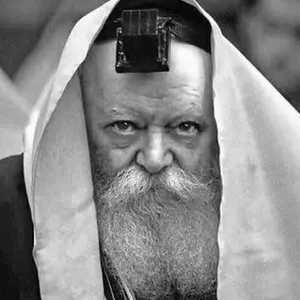

Changing the knot of the tefillin
[A] (halacha 580)
Question: One of the Rebbe's holy campaigns is the tefillin campaign. It very often happens that one needs to open the knot of the shel rosh tefillin and change it from one person to another. Is there a problem with this?
Answer: The Avnei Nezer wrote1: 'I saw fit to mention here what I learned from the Hagahos Mordechai of Chullin, that according to us, who do not hold like R' Eliyahu, one does not fulfill his obligation with tefillin except with a permanent knot, just as on Shabbos a knot is not considered [a real] knot unless it is permanent. For according to us one cannot say that the Torah called it a knot even if it is not permanent. For from where do we know this — that for us the ordinary knots of tefillin are permanent ones. And those who take other people's tefillin and change the knot to the measure of their head do not act properly, for the owners will afterwards change the knot back to the measure of their own head. It turns out that for the first one it was not permanent, and he did not fulfill his obligation. And it is a mitzvah to publicize this matter'.
That is to say, according to the Avnei Nezer the nature of the tefillin knot is like [a knot on] Shabbos, in that it must be permanent; therefore one who takes tefillin from his fellow and changes the knot to his own measure, and afterwards the owners restore the knot to its prior state, has not fulfilled the mitzvah, because the knot was not permanent.
But his student, the Gaon R' Meir Dan Plotzki, wrote in the Kli Chemdah2: 'However, regarding the essence of the words of our master the Gaon, may his memory be for a blessing for the life of the World to Come — since the world has not conducted itself this way, it appears to me to find merit [for the practice], and a student who speaks to find merit is heeded. Behold, our Rabbi, of blessed memory, himself saw that what the Ramban, of blessed memory, wrote in the Milchamos appears explicitly to the contrary. However, he forced an explanation in this... However, in my humble opinion it may be said that all agree that tefillin do not require a permanent knot, and even if it is not permanent it falls within [the verse] "u-keshartam," and the proofs of our master, may his memory be for a blessing for the life of the World to Come, from the Mordechai may be answered: that the Mordechai, of blessed memory, wrote this to resolve the opinion of Rabbeinu Eliyahu, and therefore, since we hold like Rabbeinu Tam, of blessed memory, that one need not tie [the knot] every day... it follows automatically that we say that for tefillin a permanent knot is not required, like the view of the Ramban, of blessed memory. And in truth, even according to the words of Rabbeinu Tam, of blessed memory, who holds that even if we were to say that one must tie [it] every day it is a non-permanent knot, and we do not say "migo" that since it is a knot with respect to tefillin it is a knot with respect to Shabbos — it may be said that Rabbeinu Tam, of blessed memory, said this only in the sugya of the Gemara in Eruvin there, where R' Meir and R' Yehudah hold that Shabbos is a time for tefillin and the mitzvah of tefillin is a constant mitzvah, and therefore if he unties it, it is not a permanent knot; whereas according to the halacha, where we hold that Shabbos and night are not a time for tefillin, then each day is a new mitzvah, and the mitzvah of the day is only on that day — it appears that it falls within [the category of] permanent, if he tied the knot for the entire duration of its mitzvah, and Rabbeinu Tam concedes that it falls within [the category of] permanent... And according to this there is merit to find for the world regarding what sometimes happens by chance: that after one has already prayed and another comes to request his tefillin in order to don them, and sees that the knot is not according to his measure and makes it according to his measure — he fulfills the obligation of tefillin with it, since the first one has already prayed and it was then not destined to be untied on his day and he fulfilled [the obligation] with it; and now that this one unties the knot and makes another knot, he too will not untie it on his day, and it will remain tied for the entire duration of the obligation — it falls within [the category of] permanent, and this appears correct by reasoning. But this will not avail to acquire, ab initio, tefillin for some people, and likewise a father and his son'.
The Rebbe too wrote3 that the practice is not like the Avnei Nezer, and this is his holy language: '...Regarding his question about taking the tefillin of one's fellow to pray in them, and the report he heard in the name of the Avnei Nezer... but the world has already conducted itself not so. And a strong proof for the practice is what is written plainly in OC siman 14:4 — copied also in the Shulchan Aruch of our Rabbi 12 — that it is permitted to clothe oneself in the tefillin of one's fellow, etc. And it was copied in several Acharonim, and nowhere was it explained that this applies [only] when the measure of the head matches — for in truth it only rarely happens so; and they already raised difficulties on the Avnei Nezer... And in the Kli Chemdah... he found merit for the practice of the world: (a) that tefillin do not require a permanent knot, like the Ramban; (b) that what is tied for the duration of its mitzvah is considered a permanent knot, and see there where he explains what at first glance does not appear so in Eizehu Mekoman'.
And the Rebbe wrote in Likkutei Sichos4 (in free translation): 'Although any knot that is destined to be untied is not a permanent knot, nevertheless, when this knot is made by command of the Torah, it may be said that it is considered, in several respects, a permanent knot — along the lines of "mitzvosai achshevei" — for since it is made by command of the Torah it is an eternal matter. Its actual fulfillment below is at a particular time, but its essence is eternal. And moreover: even when the untying of the knot (which is destined to be untied) is by command of the Torah, nevertheless, the knot, during the time of its existence, is considered an eternal matter, and the untying too, in its time, is an eternal matter — that is, that each one in its time is an eternal matter. And this is along the lines of what is explained in the Tanya, that "this union above is eternal forever and ever, except that below it is under [the dominion of] time." And with this is resolved the matter of the knot of tefillin, according to the opinions who hold that every day one must untie the knot and make it anew — that nevertheless it is a permanent knot'5.
And according to this there is no concern even with a father and son, or with several who purchase tefillin together, or with changing [the knot] for each person who dons them according to his measure.
In addition to the above, the Eretz Tzvi wrote6 in the name of the Shem MiShmuel7: 'After my writing, I heard that a certain man wrote this question to the holy Admo"r the author of the Shem MiShmuel, may the memory of the righteous and holy be for a blessing for the life of the World to Come, and the questioner wrote to him that the stringency of the Avnei Nezer not to change the knot is against the practice, and our master, may the memory of the righteous and holy be for a blessing, replied to him that the practice of the world is only to shorten the knot or to lengthen it, but not to untie the knot entirely — these are his pure words. From this it appears that as long as one does not untie the knot entirely, but only shortens it or lengthens it while it is still in [its] knot, it is well permitted'.
And in the Sefer HaMinhagim8 it is written: 'The world has already conducted itself to use the tefillin of one's fellow, even if they afterwards change the knot according to the measure of their head, and this does not nullify the matter of a permanent knot9'.
Therefore, in practice, one may ab initio change the knot of the shel rosh tefillin according to the measure of the one donning them, and again change it according to the measure of another person who dons them.
Notes:
1 שו"ת או"ח סי' קפג אות ה. וראה גם סימנים קפד וקפה ↩
2 פר' וילך אות ב ↩
3 אג"ק ח"י ע' שעח ↩
4 ח"א פ' שמיני אות י ע' 227 ↩
5 בשיחה יתכן שהדברים נאמרו בשי' רבינו אליהו הסובר שצריך לקשור את הקשר כל יום, אך בספר המנהגים דלקמן ציינו לשיחה זו גם לגבי מנהגנו. וראה מה שדנו בזה בשו"ת ישועת משה ח"ג סי' א. שו"ת מנחת שלמה תנינא ח"ב סי' א. שו"ת אבן ישראל ח"ט סי' ג ↩
6 שו"ת ח"א סי' ז בסופו ↩
7 בנו של האבני נזר ↩
8 ע' 5 ↩
9 ובהערה שם: וראה ג"כ לקו"ש ח"א ע' 227: 'בכ"מ שהתורה מצווה לעשות קשר, הנה ציווי התורה עושה זה ענין נצחי, עיי"ש בארוכה' ↩
From the 'Shoneh Halacha' project — daily halacha with reasons and sources
Link to the (silent) group: 'Shoneh Halacha - Minhogei Chabad'
Join the WhatsApp group